Friday, March 29, 2013

Chrism Mass

Mass of the Holy Chrism was held at St. Andrew Cathedral, considered one of the oldest churches in the Philippines. It was established in 1580 by Spanish Augustinian friars. The church is the seat of the Roman Catholic Diocese of Parañaque, the local church that comprises Parañaque City, Muntinlupa City, and Las Piñas City.

Most Rev. Jesse Mercado, D.D., Bishop of Paranaque, presided the Eucharistic Celebration. Also present was Most Rev. Teodoro Bacani, Jr., D.D., Bishop Emeritus of Novaliches.

Gospel Reading

Gospel LK 4:16-21

Jesus came to Nazareth, where he had grown up, 
and went according to his custom
into the synagogue on the sabbath day.
He stood up to read and was handed a scroll of the prophet Isaiah.
He unrolled the scroll and found the passage where it was written:

The Spirit of the Lord is upon me,
because he has anointed me
to bring glad tidings to the poor.
He has sent me to proclaim liberty to captives
and recovery of sight to the blind,
to let the oppressed go free,
and to proclaim a year acceptable to the Lord.

Rolling up the scroll, he handed it back to the attendant and sat down,
and the eyes of all in the synagogue looked intently at him.
He said to them, 
“Today this Scripture passage is fulfilled in your hearing.”


Bishop Jesse Mercado during the homily
Renewal of the priestly commitment
The blessing of the oil

The blessing of oil is very ancient – there is documented evidence of this liturgy from the fourth century, but it is certainly of earlier origin. Today the People of God, bishops, priests, deacons and the lay faithful, assemble on Maundy Thursday at St. Andrew Cathedral, for the Chrism Mass with the main celebrant Bishop Jesse Mercado. There is a long standing tradition that it takes place on the morning of Maundy Thursday in the Cathedral, where the bishop is surrounded by the priests of his diocese, whose presence demonstrates their unity with him. As Maundy Thursday is the day on which both the Mass and the priesthood were instituted, Pope Paul VI introduced the renewal of the priestly commitment into the liturgy. This is followed by the blessing of oils and the consecration of Chrism.

The Oil of the Sick and the Oil of Catechumens are plain olive oil – the Oil of Chrism is perfumed with balsam. 

Tuesday, March 26, 2013

NUESTRA SEÑORA DE GUIA

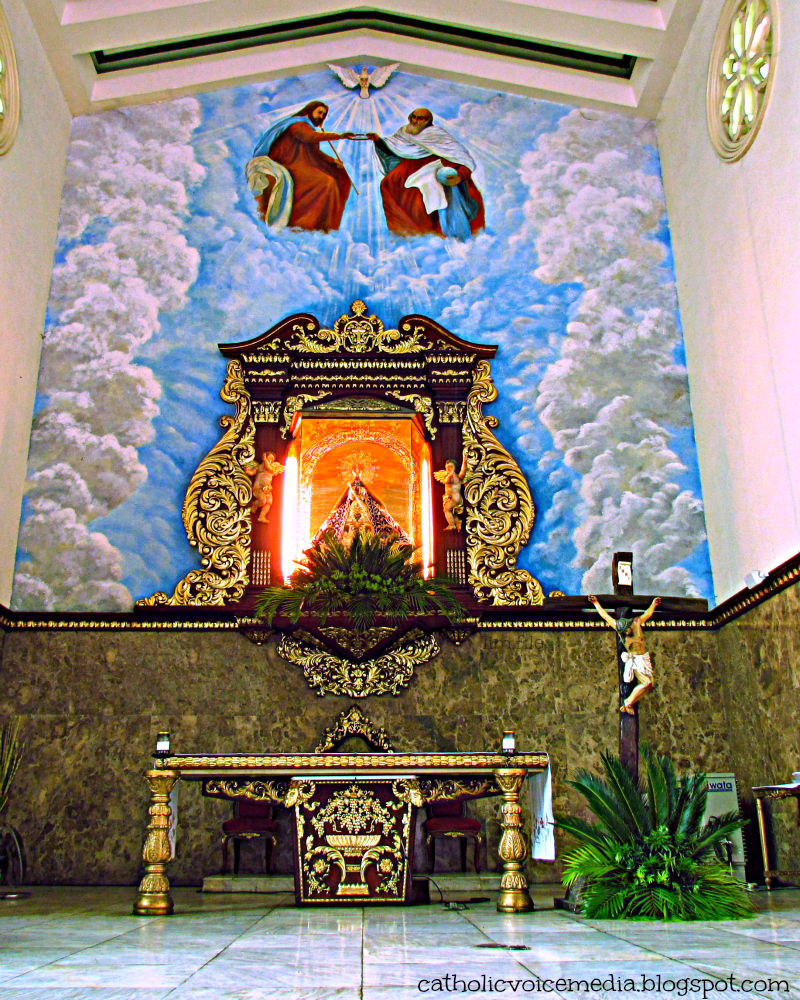
Also known as "Our Lady of Guidance", the wooden statue is the oldest Marian image in the Philippines. It was my first time to visit the Nuestra Señora de Guia Parish Church in Ermita, Manila yesterday, March 25, 2013. Here's some information I gathered about this miraculous image.

Close up photo of the original image found in Nuestra Señora de Guia
Parish Church in Ermita, Manila.


The image of Nuestra Señora de Guia (literally translated as "Our Lady of Guidance" is the oldest among all those venerated in the Philippines. On May 19 1571 (Saturday). Miguel Lopez de Legaspi took possesion of Manila in honor of the King of Spain, Felipe II. On this occasion one of his soldiers roamed places and reached as far as the seashore (now the site of the Ermita Church) and witnessed the natives pagan worship to a beautiful statue of the Virgin Mary placed on top of trunk surrounded by pandan. From that day, according to Anales dela Cathedral de Manila, the Virgen de Guia began to shed the rays of charity i never so many miracles which she wrought in behalf of the people especially the navigators. It is in this light that she was given the title Guia (guide).

It was believed that it must been brought to the Philippines in 1521 by Magellan's own ships and was later sent by the Cebu native chiefs as a gift to one of the many rajahs in Manila in a Royal Decree dated August 9, 1578, the King of Spain declared Nuestra Señora de Guia as the "Sworn Patroness" of Manila by reason of the continual favors that she lavished on it. Also, the Ermita Church where the little statue stands is the historically the foremost amongst Marian shrines in the Philippines.

With the designation of 1954 as Marian year, Nuestra Señora de Guia took on added relevance. The reason was obvious: the Marian year was the centenary of the proclamation of the dogma of the Immaculate Conception and the Nuestra Senora is the first statue of the Immaculate Conception ever set eyes upon by Filipinos.

When the church was finished, the renowed image was transffered from the Cathedral to its new temple with solemn pomp and rejoiced that lasted for eight consecutive days.

On this event a loa (praise) was composed, dialogued in regular verses by three speakers, one representing the city of Manila, another the people of Ermita, and the third the guardian angel of the town.

According to several devotees, Our Lady of de Guia had shown abundant favors to the Filipinos, most especially navigators of the ships from Spain. Whenever a galleon was scheduled to sail for New Spain, the navigators would make a novena of solemn masses with the attendance of the Cabildo Eclesiastico alternately with the religious committees.

Similarly, when the galleons were delayed in coming, they carriedhe image in procession, from her temple in Ermita winding-tip in the Cathedral. This resulted in another solemn nine-day festival during which ships from New Spain would arrive safetly in spite of turbulent seas. They attribute the arrival of these vessels to the protection given by the Virgen de Guia.

Nobody seemed to know then, how this image came to these islands. No historian could trace its source. It could have not been brought by the Europeans who were here before the conquest. Others conjectured that it could be the patroness of a vessel that lost at sea and was cast accidentally to these islands by strong waves.

The image of De Guia is brown, about fifty centimeters tall including its pedestal. The lining of its dress on tunic is of dark red silk with white parallel strips. From the waistline to its tunic, it has kind of tapis similar to that worn by our Tagalog women

Text Source: http://nuestrasenoradeguia.com/home1.html


Youth Lenten Pilgrimage 2013

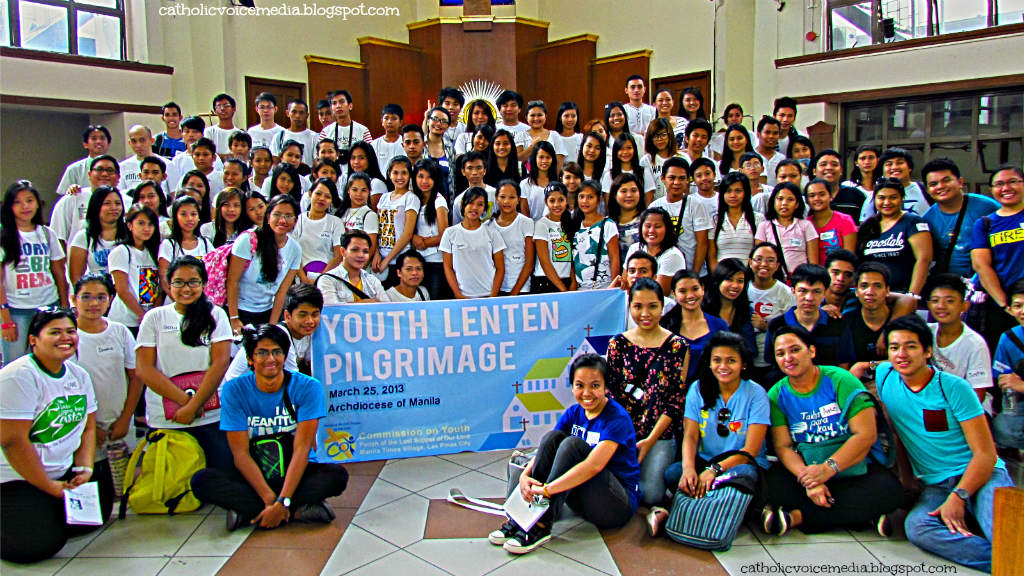
The Parish of the Last Supper of Our Lord's Commission on Youth (COY) had a successful Youth Lenten Pilgrimage last Monday, March 25, 2013. The young pilgrims visited a total of 7 churches in Manila and Pasay City. Indeed a spirit filled, great bonding activities of the youth for this Holy Week.

1. National Shrine of Saint Jude Thaddeus Manila (1st and 2nd Stations).

The present site of St. Jude Parish was donated by Archbishop Rufino J. Santos. The blessing and laying of the cornerstone of the church was held on September 28, 1958. The completed church was blessed on October 23, 1960. The weekly novena to St. Jude started in June 1959 and has been held every Thursday since then. The devotion spread over the years and has become very popular in Metro Manila. Devotees come from far and wide including students, board examination reviewees, office workers, parish and others with all kinds of requests and seemingly hopeless problems.


2. National Shrine of St. Michael and the Archangels (3rd and 4th Stations)

Rich historical background coupled with the distinction of being the National Shrine dedicated to the Holy Archangels of God. The Parish Church become an important landmark in Manila.

Prayer to St. Michael: 
St. Michael the Archangel, defend us in battle. Be our defense against the wickedness and snares of the devil. May God rebuke him, we humbly pray, and do thou, O Prince of the Heavenly Host, by the power of God, cast into hell satan and all the evil spirits, who prowl about the world for the ruin of souls. Amen.


3. San Agustin Church (5th and 6th Stations)

The Wedding Capital of the Philippines

San Agustin Church is a Roman Catholic church under the auspices of The Order of St. Augustine, located inside the historic walled city of Intramuros in Manila.

Originally known as "Iglesia de San Pablo", founded in 1571 is the oldest stone church (built in 1589) in the Philippines. It is administered by the Order of Saint Agustine (Augustinian Friars). Since the time of its foundation, the devotion to Nuestra Senora dela Consolacion y Cirrea is celebrated every Saturday. In this Church - tomb of "El Adelentado Miguel Lopez de Legaspi" Founder of the City of Manila is located in the eastermost chapel of the transept.


4. Nuestra Señora de Guia Parish Church (7th and 8th stations)

Also known as "Our Lady of Guidance", the wooden statue is the oldest Marian image in the Philippines. For more information and photos, please see related post > http://catholicvoicemedia.blogspot.com/2013/03/nuestra-senora-de-guia-wooden-statue-is.html


5. Church of Malate ( 9th and 10th Stations)

The titular patroness of this church is Nuestra Señora de los Remedios, whose statue was brought from Spain in 1624 by Rev. Juan Guevara, O.S.A. The British landed their troops near these shores in 1762 and used the church of Malate for protection for their rear-guard in the capture of Manila. This was greatly damaged by the earthquake of June 3, 1863 and was rebuilt by Rev. Francisco Cuadrado, O.S.A. The Parish  has been under the successive administration of the Augustinians, the secular clergy, the Redemptorists and the Columbans.


6. The Our Lady of Sorrows Parish Church (11th and 12th Stations)

Established 1941 by the Society of St. Paul is located at 2130 F.B. Harrison St., Pasay City, Metro Manila. It celebrates its Patronal Fiesta every first Sunday of May.


7. Archdiocesan Shrine of Jesus, The Way, The Truth and The Life (13th and 14th Stations)

The Shrine of Jesus is a project of the Archbishop of Manila, the late Jaime L. Cardinal Sin, DD whose love for the Youth is of the same fervor and intensity as the Holy Father. The land and the church was donated and built by Mr. and Mrs. Henry Sy Sr., of the Shoe Mart Group of Companies. It was consecrated and dedicated on July 9, 1999 by the late Eminence Jaime L. Cardinal Sin, DD; with His Excellency, Archbishop Antonio Franco, DD, the Apostolic Nuncio; His Eminence, Ricardo J. Cardinal Vidal, DD Archbishop of Cebu, the Archbishops and Bishops of the Philippines in the presence of a very large number of the faithful specially the youth as witness to this momentous event. On the same day, the first Shrine rector was installed in the person of Rev. Msgr. Roberto C. Canlas. (Text extracted from admin post in their website)


Palm Sunday

Palm Sunday recalls Jesus' triumphant entry into Jerusalem but its Gospel also recounts how he was betrayed  by one of his apostles and ultimately sentenced to death on a cross. According to the Gospels, Jesus rode a donkey into Jerusalem, and the celebrating people there laid down their cloaks in front of him, and also laid down small branches of trees. The people sang part of Psalm 118: 25-26 – ...Blessed is He who comes in the name of the Lord. We bless you from the house of the Lord.

My family and I attended the 6:30PM Palm Sunday Mass at URCI chapel here in Pamplona, Las Pinas City.  Blessing of the palms performed by Rev. Fr. Vincent Rozario before the Holy Mass. 


"Hosanna" in the highest!